Best Horse Racing Bet Websites for UK Punters
Your edge on the UK turf — data-driven, not hype-driven.
 Available in US
Horse racing betting generated 766.7 million pounds in gross gaming yield across the UK last year — and yet most “best betting site” guides read like they were written by someone who has never placed an each-way bet in their life. I have spent the better part of nine years pulling apart bookmaker margins, tracking regulatory shifts and watching the UK racing market shed roughly three billion pounds in turnover since 2022. The gap between what punters actually need to know and what affiliate sites bother to tell them has never been wider.
This guide exists to close that gap. I am not here to hand you a list of logos and welcome bonuses. What I will do is walk you through the numbers that shape this market right now — from the Gambling Commission’s latest GGY data to the affordability checks that are quietly reshaping how much you can stake — and then show you which features genuinely move the needle when you are choosing where to put your money down on UK and Irish racing.
766.7m pounds
Gross gaming yield from online horse racing betting in 2024/25
3,086
Licensed gambling operators in the UK as of March 2025 — down 2.3% year-on-year
7%
Share of UK adults who bet on horse racing in a typical four-week window during peak season
Whether you are a seasoned punter looking for sharper odds or someone placing your first bet ahead of Royal Ascot, the sections below cover everything from market data and ranking methodology to bet types, tax reform and the responsible gambling tools that actually work. I have kept the marketing fluff out and the data in.
Table of Contents
- What Nine Years of Market Data Tells You Before You Pick a Site
- UK Horse Racing Betting Market in Numbers
- How We Rank Horse Racing Betting Sites
- Best Horse Racing Betting Sites for UK Punters
- Features That Matter: BOG, Cash Out and Extra Places
- Horse Racing Bet Types at a Glance
- Licensing, Tax and the Regulatory Landscape
- Affordability Checks: What UK Bettors Need to Know
- Responsible Gambling: Beyond the Disclaimers
- Frequently Asked Questions
What Nine Years of Market Data Tells You Before You Pick a Site
- UK horse racing betting yielded 766.7 million pounds in GGY for 2024/25, but total turnover has dropped 9% in Q1 2025 alone — the market is contracting, and bookmaker behaviour is shifting with it.
- Best Odds Guaranteed, live streaming access and each-way place terms are the three features that separate a useful racing account from a decorative one. Ignore the welcome bonus noise.
- Affordability checks now affect nearly one in four bettors surveyed, and over half of respondents to a BHA poll said they would cut or stop betting if checks tighten further.
- Horse racing retains a 15% General Betting Duty while Remote Gaming Duty for other products jumps to 40% from April 2026 — a regulatory split that directly shapes what bookmakers promote and where they invest.
- Problem gambling prevalence sits at 2.7% of UK adults scoring 8+ on the PGSI, rising to roughly 10% among 18-to-24-year-olds. The tools exist to manage risk; using them is not optional.
UK Horse Racing Betting Market in Numbers
I remember a conversation at Cheltenham in March 2023 where a trading manager from one of the big three operators told me, half-joking, that the racing desk was “subsidised by slots.” Two years on, the numbers confirm it was not really a joke. The total gross gaming yield for the UK’s remote casino, betting and bingo sector hit 7.8 billion pounds in 2024/25, and online casino — overwhelmingly slots, which alone generated 4.2 billion pounds — accounted for roughly 5 billion of that. Horse racing’s online GGY came in at 766.7 million pounds. Significant money by any standard, but a fraction of the casino side, and a figure that barely moved from the previous year’s 771.1 million.
7.8bn pounds
Total GGY for remote casino, betting and bingo in 2024/25
-9%
Year-on-year decline in total betting turnover on UK racing in Q1 2025
~3bn pounds
Cumulative turnover losses on British horse racing since 2022
That turnover picture is where the real story lives. Richard Wayman, Director of Racing at the British Horseracing Authority, put it plainly: total betting turnover fell 9% in Q1 2025 compared with the same period in 2024, and he acknowledged a “much wider range of factors” behind what he called a “concerning decline.” Those factors include affordability checks squeezing higher-staking punters, the competitive pull of football and in-play markets, and a general shift in how operators allocate marketing budgets.
Dig deeper and the split between fixture types becomes stark. Core fixtures — your everyday midweek cards at places like Southwell, Wolverhampton, Catterick — saw turnover drop 14.4% year-on-year, while Premier meetings held roughly steady. The implication is that casual and mid-level punters are retreating from the daily product while festival and feature-race betting remains resilient. For anyone choosing a betting site, this matters: the operators investing in streaming, data and pricing for those everyday cards are the ones still competing for your attention outside of Cheltenham week.
Since 2022, the cumulative losses in turnover on British racing amount to approximately three billion pounds once inflation is factored in. The 2024/25 turnover figure sits 15% below 2022/23 and 19% below 2021/22. Meanwhile, the broader UK online gambling market was valued at 8.7 billion dollars in 2024, with projections reaching 13 billion dollars by 2033 at a compound annual growth rate of 4.39%. The overall GGY for Q2 2025 came in at 4.3 billion pounds — up 3.5% year-on-year. So the gambling industry is growing; horse racing’s slice of it is not. That divergence should inform every decision you make about where and how you bet on the sport.
Online slots alone generated over 4.2 billion pounds in GGY during 2024/25 — more than five times what horse racing produced. The racing desk really is, as one trading manager once put it to me, subsidised by slots.
How We Rank Horse Racing Betting Sites
A few years ago I started keeping a spreadsheet — ugly thing, colour-coded by frustration level — where I logged every time a bookmaker did something that would annoy a serious racing punter. Suspended cash-out mid-race, BOG quietly removed from a meeting, minimum bet requirements buried three clicks deep. That spreadsheet eventually became the framework I use today, and the criteria below reflect what nine years of daily betting on UK and Irish racing have taught me actually matters.
Most comparison sites score bookmakers on a vague mix of “user experience” and “bonus generosity.” I do not. My ranking is built around five measurable dimensions, weighted by how directly each one affects your returns over a season of betting rather than your experience during a single promotional sign-up.
Ranking Criteria for Horse Racing Betting Sites
- Odds competitiveness and margin transparency — I compare SP and early prices across a sample of UK and Irish fixtures, not headline races. A site that offers sharp odds on a Tuesday at Kempton matters more than one that leads the market on the Gold Cup favourite.
- Racing-specific feature depth — Best Odds Guaranteed coverage (which meetings, which bet types), each-way extra places frequency, Non-Runner No Bet availability, and whether the operator actually applies these features without requiring you to opt in.
- Live streaming breadth and quality — How many UK, Irish and international fixtures are covered, what the minimum bet or balance requirement is to access streams, and whether the stream runs reliably on mobile without buffering through the final furlong.
- Cash-out functionality on racing markets — Whether partial cash-out is available on each-way and accumulator bets, how quickly the cash-out price updates during a race, and whether the operator suspends cash-out at the moments you most want to use it.
- UKGC licensing and responsible gambling tools — Active licence status, deposit limit configurability, reality checks, cool-off periods and self-exclusion integration with GAMSTOP. With 3,086 licensed operators on the register as of March 2025, a valid licence is the baseline, not the differentiator — it is the quality of the safer gambling toolkit that separates sites.
I deliberately exclude welcome bonuses from the ranking weighting. A twenty-pound free bet is spent in one race. The margin on your odds, the BOG policy and the streaming access shape every bet you place for the next twelve months. That is where the value compounds, and that is what I measure.
Best Horse Racing Betting Sites for UK Punters
Picking a single “best” site for horse racing is a bit like picking a single horse to follow all season — it depends entirely on what you are trying to do. Some punters live and die by the price. Others will not open an app that does not stream the 2:30 at Wetherby. A few care more about getting their money out quickly than about the extra place on a handicap. What I have found over the years is that the punters who do best are the ones running two or three accounts, each chosen for a specific strength, rather than searching for one site that does everything.
The UK market currently has 24.4 million active betting accounts across licensed remote operators, with 34 million new registrations logged in the last reporting year — down 4.1% on the year before. That is a lot of accounts, and a lot of choice. Below, I break the landscape into the four categories that matter most for racing, so you can match your priorities to the right type of operator.

Best for Odds and Margins
The single biggest lever on your long-term returns is not the welcome bonus. It is not the app design. It is the margin baked into every price you take. I have tracked odds across a rotating panel of UK fixtures for years, and the variance between the best-priced and worst-priced bookmaker on the same horse in the same race routinely sits between 5% and 15% in implied probability terms. On an 8/1 shot, that difference can mean an extra ten pounds returned on a five-pound stake. Multiply that across hundreds of bets and the compounding effect is enormous.
What to look for: operators that consistently price closer to the tissue — the morning forecast compiled by course officials and industry handicappers. An operator whose SP regularly drifts above the tissue is absorbing less margin. You will not find this information on the site itself; it requires checking prices at declaration time and again near the off. Tools that aggregate odds across multiple bookmakers exist and are worth using as a daily habit, not a once-a-year exercise.
Best Odds Guaranteed is the other half of this equation. A site with BOG on all UK and Irish racing effectively gives you a free option: take the early price, and if SP drifts higher, you get the better number. The value of that optionality depends on how early you bet and how volatile the market is for the race type you favour. I have seen BOG add meaningful value on competitive handicaps where the market moves sharply in the final hour.
Best for Live Streaming
Live streaming used to be a nice extra. Now it is the primary way most online punters watch the racing they bet on, and the gap in coverage between operators is wider than you might expect. Some stream virtually every UK and Irish fixture; others limit coverage to selected meetings or require a minimum bet on the race before the stream unlocks. A funded account with a penny balance is not always enough.
Streaming coverage, minimum bet requirements and mobile performance vary significantly between operators. For a side-by-side breakdown, see the full guide to horse racing live streaming through betting sites.
If you are someone who watches a race before betting the next — studying how a horse travels, how a jockey positions in the pack — then the quality of the stream matters as much as its existence. A laggy, low-resolution feed that runs fifteen seconds behind the betting market is worse than no stream at all, because the cash-out and in-play prices will have moved before you see the action. Test streams on your phone during a midweek card before you commit to using a site for a Saturday feature.
Best for Mobile Betting
I placed my first mobile racing bet in 2014 on a phone that could barely load a racecard. The apps have come a long way, but the gap between the best and worst mobile experience in UK racing betting is still surprisingly large. Speed matters — not page-load speed in a marketing sense, but the number of taps between opening the app and confirming a bet on a specific horse. In a fast-moving ante-post market or an in-play window, three extra taps is the difference between getting the price and watching it shorten.
I tested the leading UK horse racing betting apps on both Android and iOS, scoring them on speed, navigation, streaming integration and cash-out reliability. The detailed rankings are in the horse racing betting apps guide.
Beyond speed, look for apps that surface racing-specific data natively: form at a glance, trainer and jockey stats, going reports, and non-runner alerts pushed before you open the app. An operator that treats its racing section as a reskinned football interface is telling you where its priorities lie.
Best for Free Bets and Promotions
Free bets are the loudest part of any bookmaker’s pitch and, ironically, the part that matters least over time. A thirty-pound sign-up offer sounds generous until you read the wagering terms: stake-not-returned conditions, minimum odds thresholds, seven-day expiry windows. The real value of that thirty pounds, once you account for the probability of meeting the conditions and the restrictions on what you can bet on, is often closer to ten or twelve pounds.
I break down the maths behind retention value and flag the UK racing offers that are genuinely worth claiming in the horse racing free bets guide.
Where promotions do matter is in the racing-specific offers that run throughout the season: extra places on handicaps, money-back if your horse finishes second to the favourite, enhanced each-way terms for festival meetings. These are ongoing value, not one-off sign-up theatre. The operators that invest in these recurring promotions for racing — rather than reserving all their marketing spend for football accumulators — are the ones signalling that they still care about the racing product.
Features That Matter: BOG, Cash Out and Extra Places
Three features come up in every conversation I have with racing punters, and all three are misunderstood more often than they are used well. Let me be clear about what each one actually does for your bottom line.
Best Odds Guaranteed (BOG) — a policy where the bookmaker pays out at whichever is higher: the price you took when you placed the bet or the starting price (SP) returned at the off. It is free upside, but only applies to specific race types and bet types, and the terms vary by operator.
BOG is the closest thing to a structural advantage that an ordinary punter can get from a traditional bookmaker. Alex Frost, CEO of the UK Tote Group, has pointed out that horse race betting operators carry a triple burden: gambling duty, a responsible gambling levy and the horserace betting levy. That cost structure puts pressure on margins, and BOG is one of the areas where operators absorb risk to attract racing customers. The practical effect for you is that early-price betting on UK and Irish racing becomes a free option rather than a gamble on market direction. If the SP drifts out, you win more. If it comes in, you keep your original price. The mechanics and worked examples are covered in detail in the Best Odds Guaranteed guide.
Cash Out — a feature that lets you settle a bet before the event finishes, locking in a profit or cutting a loss based on the current implied probability of your selection winning. Partial cash-out allows you to take some money off the table while leaving a portion of the bet running.
Cash-out on horse racing is more volatile than on football because the market moves faster and the event is shorter. A horse can go from 2/1 to 5/1 in the space of a furlong if it stumbles or loses position. The cash-out price updates in near-real-time, but “near” is doing a lot of work in that sentence — there is always a lag, and operators reserve the right to suspend cash-out during periods of rapid market movement. I have lost count of the times I have pressed the cash-out button only to see “price has changed” flash up. The feature is useful as a risk management tool, but it is not a trading platform, and treating it like one will cost you.
Extra Places — a promotion where the bookmaker pays out on more place positions than the standard each-way terms for a race. A race that normally pays four places might pay five or six under an extra-places offer.
BOG in Action: A Quick Illustration
Suppose you back a horse at 10/1 early in the morning. By the time the race starts, the SP has moved to 14/1. With BOG, you are paid out at 14/1 rather than your original 10/1.
On a ten-pound win stake, that is the difference between a return of 110 pounds and a return of 150 pounds — forty pounds of extra value for doing nothing more than being with a BOG-eligible operator.
Without BOG, you are locked into your original price regardless of market movement. That forty-pound gap is not a fringe case; it happens regularly on competitive handicaps where the market shifts in the final hour.
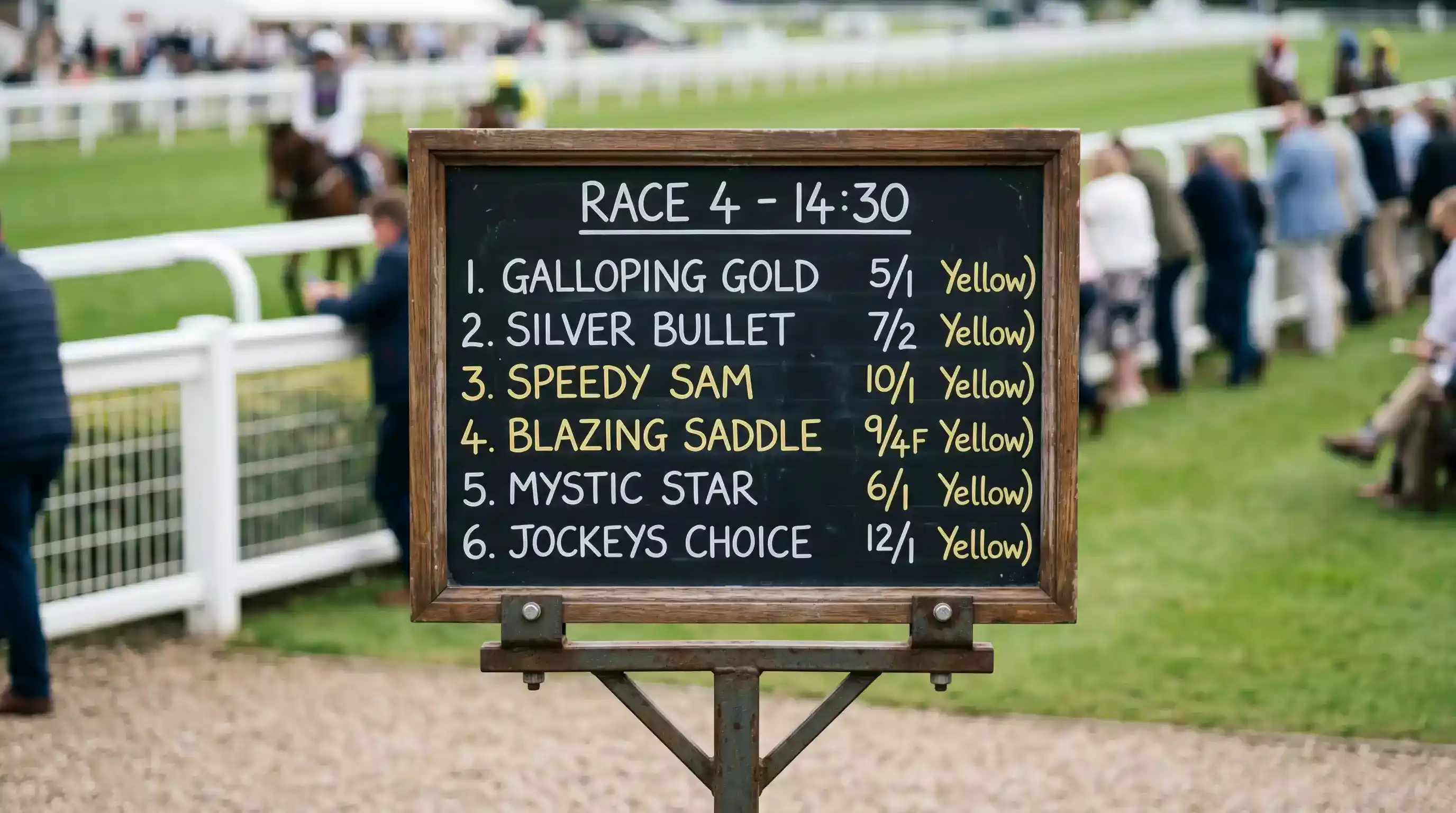
Extra places are quietly one of the most valuable racing-specific promotions available. On large-field handicaps — the type of race you see at Cheltenham, the Grand National meeting and big Saturday cards — the fifth and sixth place positions account for a meaningful chunk of finishing outcomes at longer odds. An each-way bet on a 20/1 shot that finishes fifth in a 20-runner handicap is dead money under standard terms but returns a place dividend under an extra-places offer. The key is checking which races carry the extra-places promotion before you bet, not after.
Horse Racing Bet Types at a Glance
When I started betting on racing, I stuck to win bets for about six months because the rest looked like a foreign language. Trixies, Yankees, Lucky 15s — they sounded like cocktails, not wagers. The reality is simpler than the names suggest, and understanding the full range of bet types opens up value that pure win-bet punters miss entirely.
At its most basic, horse racing betting splits into two branches: single bets and multiple bets. Singles are straightforward. You pick a horse, choose whether you want it to win or to place (finish in the top two, three or four depending on the field size), and that is your bet. A win single is the purest form: your horse wins, you get paid; it does not, you lose your stake. A place single pays at a fraction of the win odds if the horse finishes within the place terms — typically 1/4 or 1/5 of the win price.
Each-way (E/W) — a bet that is actually two bets in one: a win bet and a place bet at the same stake. If your horse wins, both parts pay out. If it places but does not win, only the place part pays. Your total stake is double the unit stake.
Each-Way Return Calculation
Suppose you place a five-pound each-way bet on a horse at 12/1 in a race paying 1/4 odds for places (first four home in a 16-runner handicap). Your total outlay is ten pounds (five pounds win, five pounds place).
If the horse wins: Win part returns 5 x 12 + 5 = 65 pounds. Place part returns 5 x 3 (which is 12/4) + 5 = 20 pounds. Total return: 85 pounds on a 10-pound stake.
If the horse finishes third: Win part loses. Place part returns 5 x 3 + 5 = 20 pounds. You are up 10 pounds on your 10-pound outlay.
If the horse finishes fifth: Both parts lose. You are down 10 pounds.
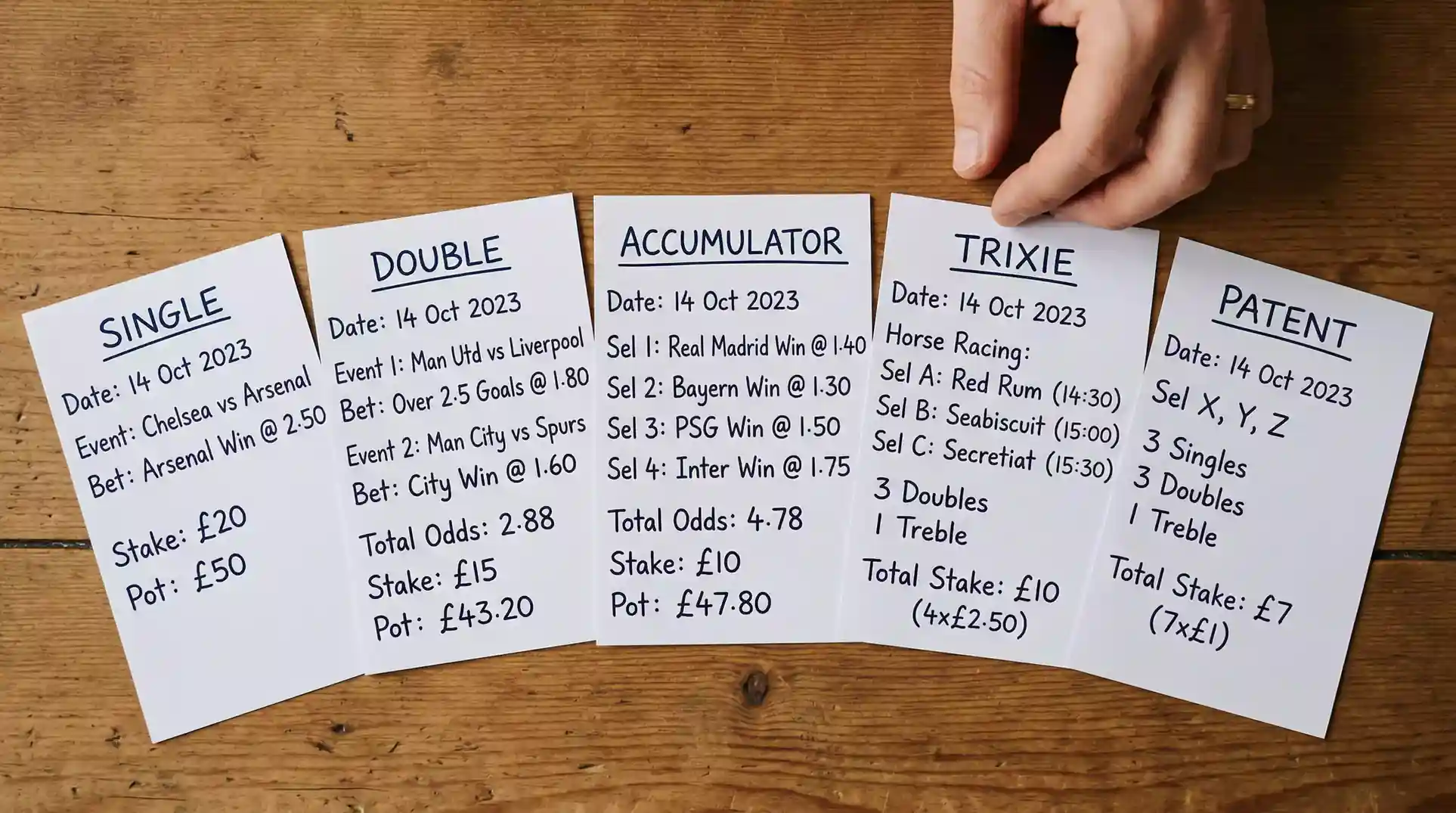
Multiples are where things get interesting — and riskier. A double links two selections; both must win. A treble links three. An accumulator (acca) chains four or more, and the odds multiply, which is why a five-fold acca at modest individual prices can return eye-watering sums. The catch is obvious: one loser kills the entire bet.
Trixie — four bets covering three selections: three doubles and one treble. Two of your three picks must win for any return.
Yankee — eleven bets covering four selections: six doubles, four trebles and one four-fold accumulator. Two winners needed for a return, but the payout scales sharply with three or four winners.
Full-cover bets like trixies, Yankees and Lucky 15s are designed to give you a return even when not every selection wins. They cost more — a Yankee is eleven separate bets at your unit stake — but they smooth the variance compared with a straight accumulator. Whether that trade-off suits you depends on your staking approach and how confident you are across all four legs. I tend to use trixies on days where I have three strong opinions from different meetings; the protection of the doubles layer has saved me more times than I care to count.
There are also specialist bet types worth knowing: forecasts (picking the first and second in correct order), tricasts (first, second and third), and combination versions of both that cover all possible orders for a higher stake. These tend to offer large payouts on small stakes, particularly in competitive handicaps, but they are inherently low-probability and should be treated as entertainment rather than strategy.
Licensing, Tax and the Regulatory Landscape
For years I treated the regulatory section of betting guides the way most people treat the safety card on an aeroplane — technically important, practically ignored. Then the 2025 Autumn Budget landed, and suddenly the tax structure of UK gambling became the single most important factor shaping what bookmakers offer, what they promote and how aggressively they price horse racing markets. If you want to understand why your favourite operator just tweaked its BOG terms or pulled back on streaming coverage, this is where the answer lives.
From 1 April 2026, Remote Gaming Duty rises from 21% to 40%. Sports betting duty for non-racing products increases from 15% to 25% from April 2027. The Treasury expects these changes to generate an additional 1.1 billion pounds per year by 2029. Horse racing bets, however, retain the existing 15% General Betting Duty rate.
That last point is critical. Horse racing’s 15% duty — combined with the 10% Horserace Betting Levy on bookmaker profits above 500,000 pounds — gives racing an effective tax rate of 25%. Before the Budget, that looked like a burden. After the Budget, with casino and general sports products facing 40% and 25% respectively, it looks like a relative advantage. Brant Dunshea, then acting CEO of the British Horseracing Authority, described the decision to keep racing’s rate at 15% as “an important step by the Government to help preserve revenue streams and protect the 85,000 jobs supported by racing across the country.” The subtext: had racing been lumped into the higher rate, the modelling suggested it would have cost the industry roughly 66 million pounds annually and threatened nearly 2,800 jobs.
Horse racing’s combined effective tax rate of 25% (15% duty plus 10% levy) is now lower than the standalone Remote Gaming Duty rate of 40% that applies to online casino products from April 2026.
For punters, the practical implication is that operators facing higher duties on their casino and football products may redirect some commercial focus toward racing, where the tax burden is lighter. Alternatively, they may reduce investment in racing as a lower-margin product that does not justify the operational complexity. Both outcomes are plausible, and both are already playing out in different ways across the market. What is certain is that any site you choose will be making strategic decisions shaped by this tax split, and those decisions will affect your odds, your promotions and the features you have access to.
The Treasury also committed an additional 26 million pounds to the Gambling Commission specifically for tackling the unlicensed market — a recognition that tighter regulation without enforcement simply pushes activity offshore. Every operator you bet with should hold an active UKGC licence, and checking that licence takes thirty seconds on the Commission’s public register. It is the absolute minimum due diligence before you deposit a penny.
Affordability Checks: What UK Bettors Need to Know
No topic in UK racing betting generates more heat and less light than affordability checks. I have watched forum threads run to 400 replies on this subject, most of them fuelled by anger rather than data. So here is what the data actually says.
The share of bettors who have been subject to some form of affordability check rose from 16.6% in 2023 to 23.7% in 2025, according to the Racing Post’s Big Punting Survey. That is nearly one in four respondents. Even among those staking a relatively modest average of ten pounds per bet, the proportion experiencing checks climbed above 20%. These are not niche interventions hitting only high rollers; they are spreading down the staking spectrum.
The industry response has been vocal. A BHA survey found that 52% of respondents said they would significantly reduce or stop betting on horse racing entirely if affordability checks were tightened further. Nevin Truesdale, then CEO of The Jockey Club, argued that the Gambling Commission appeared to want to reduce gambling to “just small-stakes gamblers and that can’t be right.” The pushback is not only philosophical — there is a direct commercial link. Every pound diverted from licensed operators by overly intrusive checks is a pound that no longer contributes to the levy, no longer funds prize money, and no longer supports the jobs and infrastructure that racing depends on.
Affordability checks are regulatory interventions where operators request financial information from bettors to assess whether their gambling activity is within their means. They can be triggered by net deposit thresholds, unusual staking patterns or algorithmic flags — and the exact triggers are not publicly standardised.
The deeper concern is displacement. If punters who face intrusive checks on licensed sites simply move to unlicensed operators — and the data suggests a growing number are doing exactly that — then the checks fail on both their consumer protection and their revenue protection objectives.
Affordability checks exist within a broader conversation about responsible gambling — a conversation that, in most betting guides, begins and ends with a “18+ GambleAware” sticker at the bottom of the page. The next section goes further.
Responsible Gambling: Beyond the Disclaimers
I have a rule for myself that I set years ago and have never broken: I do not bet on a day when I have had a losing run of five or more and feel the urge to chase. Not because I am uniquely disciplined — I am not — but because I once watched a friend, a sharp punter by any measure, burn through a month’s profit in a single afternoon trying to recover a bad Saturday. The tools to prevent that exist on every licensed site. The question is whether anyone actually uses them.
The numbers suggest the problem is real and growing. According to the Gambling Survey for Great Britain, 2.7% of UK adults scored 8 or above on the Problem Gambling Severity Index — the threshold for clinically significant problem gambling. Among men, that figure reaches 6%. Among 18-to-24-year-olds, it climbs to approximately 10%. These are not hypothetical risks. They are people losing money they cannot afford to lose, and a disproportionate number of them are young men — the exact demographic most aggressively targeted by betting promotions.
Do
- Set a weekly deposit limit before you start, not after you have had a bad run. Every UKGC-licensed site is required to offer this.
- Use reality checks — timed alerts that tell you how long you have been logged in and how much you have deposited or lost in the session.
- Take cool-off periods during festival weeks. The intensity of Cheltenham or Royal Ascot can compress a month’s staking into five days, and the emotional momentum is hard to resist.
- Register with GAMSTOP if you need to self-exclude from all licensed UK gambling sites simultaneously. It covers online operators; for racecourse bookmakers, separate self-exclusion schemes apply.
Don’t
- Rely on willpower alone. Behavioural research consistently shows that pre-commitment tools (deposit limits, session timers) outperform in-the-moment decisions.
- Treat betting losses as problems that more betting can solve. The chase is the single most reliable predictor of escalating harm.
- Ignore signs that your betting is affecting sleep, mood, finances or relationships. These are not signs of bad luck; they are signs that the activity has moved from entertainment to harm.
- Assume that being a “skilled” punter makes you immune. Problem gambling prevalence does not correlate with betting ability — it correlates with frequency, intensity and the absence of structural safeguards.

Participation in horse racing betting peaks at around 7% of UK adults during the spring and summer season, dropping to 4% in the off-peak months. Sixteen percent of men reported placing a bet in the previous four weeks compared with 4% of women. These participation figures are drawn from the Gambling Commission’s Gambling Survey for Great Britain and reflect the seasonal rhythm of the sport.
I am not going to pretend that a paragraph in a betting guide will change anyone’s relationship with gambling. What I will say is that every operator I rank in this guide is required by its UKGC licence to offer deposit limits, session time alerts, self-exclusion and links to support organisations. If the site you are using makes those tools hard to find, or if you have never once looked at where they are in your account settings, that itself is information worth sitting with.
Frequently Asked Questions
What is Best Odds Guaranteed in horse racing betting?
Best Odds Guaranteed is a bookmaker policy that pays out at whichever is higher — the price you took when you placed your bet or the official starting price at the off. If you back a horse at 6/1 in the morning and it goes off at 9/1, you get paid at 9/1. The policy typically applies to win and each-way bets on UK and Irish horse racing, though individual operators set their own terms on which meetings and bet types qualify. BOG effectively removes the risk of taking an early price that later proves to be below market value.
How do I choose the best horse racing betting site in the UK?
Focus on four things: odds competitiveness on everyday racing fixtures (not just headline races), the breadth and terms of Best Odds Guaranteed coverage, live streaming access without prohibitive minimum bet requirements, and the quality of racing-specific features like extra places and Non-Runner No Bet. Welcome bonuses matter far less than these structural advantages because they affect one bet, while odds and features shape every bet you place over a season. Running two or three accounts with operators that lead in different areas is more effective than looking for a single site that does everything.
What types of bets can I place on horse racing?
The main types are win singles (your horse must finish first), place singles (top two, three or four depending on field size), each-way bets (a win bet and a place bet combined), and multiples including doubles, trebles and accumulators. Full-cover bets like trixies (three selections, four bets), Yankees (four selections, eleven bets) and Lucky 15s (four selections, fifteen bets) give you a return if only some of your picks win. Forecasts and tricasts let you predict the exact finishing order of the first two or three horses for higher payouts at lower probability.
Is online horse racing betting legal in the UK?
Yes. Online horse racing betting is fully legal in the UK under the Gambling Act 2005, provided the operator holds a valid licence from the UK Gambling Commission. There are currently 3,086 licensed operators as of March 2025. You must be 18 or over to bet, and operators are required to verify your identity before allowing withdrawals. Betting with an unlicensed operator is not a criminal offence for the punter, but you lose all consumer protections — there is no recourse if the operator refuses to pay out, misuses your data or closes without returning balances.
How does each-way horse racing betting work in simple terms?
An each-way bet is two bets in one: a win bet and a place bet, both at the same stake. If your horse wins, both parts pay out. If it finishes in a place position (but does not win), only the place part pays — at a fraction of the win odds, typically 1/4 or 1/5 depending on the race. Your total outlay is double the unit stake: a five-pound each-way bet costs ten pounds. Each-way betting is most valuable in large-field races at longer odds, where the place part provides a meaningful return even if the horse does not win.
What are affordability checks and how do they affect horse racing bettors?
Affordability checks are regulatory interventions where licensed operators request financial documentation from bettors to assess whether their gambling is within their means. They can be triggered by net deposit thresholds, unusual staking patterns or algorithmic flags. Nearly 24% of bettors surveyed in 2025 reported being subject to these checks, up from 17% in 2023. The checks can result in stake limits, account restrictions or requests for proof of income. Over half of respondents in a BHA survey said they would reduce or stop betting on racing if checks became more intrusive, and there is growing evidence that some displaced bettors are moving to unlicensed operators.
Can I live stream horse racing through betting sites?
Most major UK-licensed betting sites offer live streaming of horse racing, covering varying numbers of UK, Irish and international fixtures. Access typically requires a funded account, and some operators also require a minimum bet on the race or meeting before the stream unlocks. Coverage, stream quality and mobile performance vary significantly between operators. A site that streams 95% of UK fixtures with no minimum bet requirement provides meaningfully more value than one that covers selected meetings only. Check the streaming terms on your specific operator, and test the stream quality on a midweek card before relying on it for a Saturday feature race.
Created by the ”Horse Racing bet Website” editorial team.